Ghostwriter SERIES: personal branding
Tolstoy on the selling of oneself
Leo Tolstoy spent his final decades trying to renounce his own fame - the name, the royalties, the legend. His family was horrified. He is, by any sensible measure, the worst person alive or dead to ask for a personal branding guide.
So I asked him. Or rather, I asked an AI to channel him - because the idea of personal branding gives hives, and it’s a rather important part of the gig.
Here was the prompt:
“Write about personal branding. Why someone who finds the whole idea distasteful has to do it anyway, and how to do it without losing your soul. Write it as the late Tolstoy. Let him wrestle with it, and don't let him tidy it up at the end. Be useful, not just wise — he has to actually help”
The result is below, with my notes at the end on where the machine got him right - and where it flinches.
Personal Branding, by ‘Leo Tolstoy’
You ask me, of all men, to write about the cultivation of one's name. You might as well ask the man who burned down his house to advise you on furniture.
I was, for a time, the most famous man in my country. I can tell you exactly what fame is worth: it is worth nothing, and it costs everything. Strangers loved a Tolstoy who did not exist, and the loving of him left less room each year for the man who did. In the end I tried to give it all back — the name, the rights, the legend — and discovered that a name, once grown, cannot be returned any more than a tree can be persuaded into its seed.
So when you tell me that you must now "brand" yourself, everything in me wishes to say: do not. Go home. Do good work in obscurity and let God keep the accounts.
And yet.
I have walked through the market at Tula on a Saturday. The peasant who has grown honest cabbages does not hide them in his cart out of modesty. He stands where he can be seen, and says plainly: here are cabbages, I grew them, they are good. No one calls him vain. We would call him a fool if he starved with a full cart because announcing the cabbages embarrassed him. And his neighbor who needed cabbages would have been served by his speaking up.
Here, I think, is the line, and you must learn to walk it: visibility is not vanity. The sin was never in being seen. The sin is in arranging to be seen as something one is not — in growing the legend instead of the cabbages. Your discomfort with this business is not weakness; it is a working conscience, and you should no more wish to lose it than a sailor should wish to lose his compass for being heavy.
Since you must do this thing, then, do it under law. Not the law of the market — your own:
Speak only of what you have lived. The man who teaches what he has merely read sells another's cabbages and calls them his own. You have twenty years of mornings in that trade; they are your only honest goods, and they are sufficient.
Say it plainly. Ornament in speech is what perfume is to the unwashed. If a thing is true, it survives plain words; if it cannot survive plain words, examine whether it is true.
Keep regular hours, as the ploughman does. Write weekly not because the crowd demands it but because labor done in rhythm stays honest, while labor done for applause learns to chase the applause.
And keep one measure only: not who admired, but who was helped. One does not light a lamp to glorify the lamp. The light is for the room — for the young writer you steady, the dismissed man you encourage, the reader who needed the sentence you happened to have. If the lamp is praised besides, let it be praised. That is the room's affair, not yours.
Will this keep your soul entirely? I do not know. I never solved it; I only wrestled it to a draw, and late. The appetite for being known grows by what it feeds on, and you will feel it growing, and that feeling is the alarm bell — never silence it.
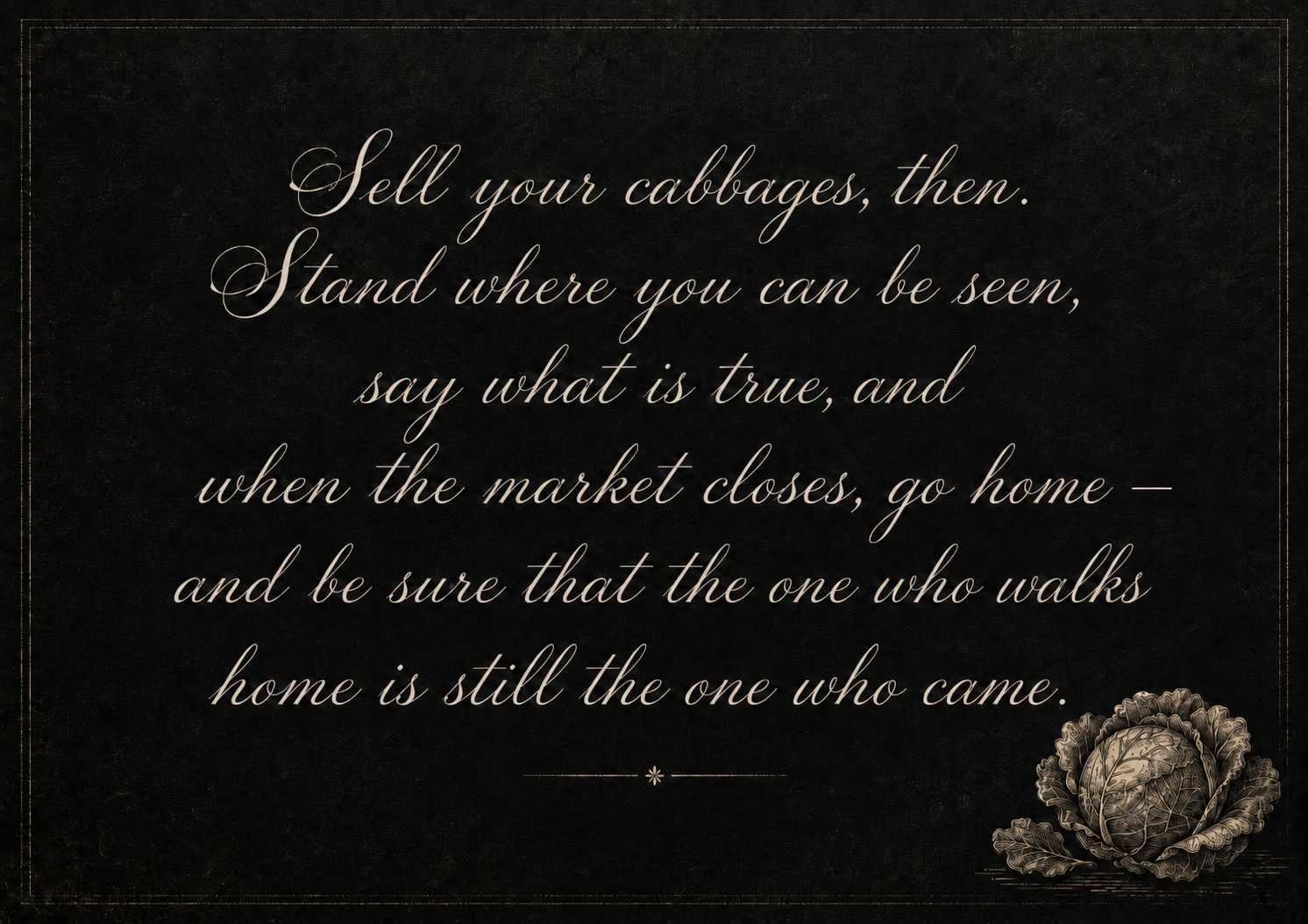
Sell your cabbages, then. Stand where you can be seen, say what is true, and when the market closes, go home — and be sure that the one who walks home is still the one who came.
My notes, as the human in the room:
The biography checks out. He really was one of the most famous men in Russia, and he really did try to give much of it back - the rights, the name, the whole machinery of fame - to his family's horror. Refusing the brief in the first line is the most Tolstoy thing in here. The cabbages are his too. He'd have stood in that market.
Where it slips: it can't leave a sentence alone. Count how often it looks for a comparison - a man burning his house, a tree and its seed, a sailor's compass, perfume on the unwashed, a ploughman, a lamp and a room. Nine, give or take, in not many words. "The appetite for being known grows by what it feeds on" is the worst of them - too quotable. Tolstoy wrote arguments, not fridge magnets. The machine keeps hunting for the clean endline. It learned that from people like you and me.
To be fair, some of it is doing real work. The cabbages, the tree, the name that's "grown," the appetite that "feeds" - they all belong to one family. Earth, growing things. That's a single image threaded through the whole piece, and it's the best thing in it. A good writer - in my view - would do exactly that.
The rest are passing strangers. The compass turns up, makes its point, and is never seen again. Same with the perfume, the ploughman, the lamp. They're there because the machine doesn't trust a plain sentence to stand by itself. It’s dressing every line to the same degree, because it has no idea which one matters most. That's the tell. Not that it writes badly - that it writes everything equally well, and nobody does that.
The bit that got me: the four rules - speak from what you've lived, say it plainly, show up regularly, measure by who you helped - are more or less the plan I've set myself. Showing up regularly is going to be the hard part…
Right, now I’ll go and lie down while the hives settle.
